

Don’t say it, don’t say it, don’t say it.
Hot take: your website is not the first step in building your business; it is one of the last.
*gasp*
The audacity.
I can *hear* the collective gasp. But hear me out.

Almost always, I see creative business owners dive right into their projects.

They buy a domain, pick a template, and choose fonts. Then they stall. The copy doesn’t flow. The photos feel random. The colours don’t feel “right.” Nothing is cohesive—and they can’t explain why.

The typical reason? They skipped brand identity and went straight to the website.
It’s like decorating a house before you know who lives there. You end up with a beautiful shell that doesn’t feel like home.

I’ve built enough websites to know which ones come together in no time. It’s always the ones that sort the brand identity first. The projects that drag on for months? They usually have a brand clarity issue that looks like a design problem.
Before diving into Showit, explore Notion templates or pick a stock photo. Let’s discover who your brand truly is.
In this post, you’ll learn:
- Why brand identity comes before website design (the order matters)
- The 7 things to define before you build anything
- How to find your brand voice (exercises included)
- Visual identity basics: colours, fonts, mood board
- The “Never List”—words your brand will never use
- How to know when you’re ready to build
This is the starting point of a whole series. Once you have your brand identity sorted, everything else follows from there—copy, photos, SEO, project management, and launch.
Why Brand Identity Comes First
Your website is an expression of your brand—not the brand itself. If you don’t know what you’re expressing, the website will feel directionless.

The Effective Order
Here’s the order that actually works:
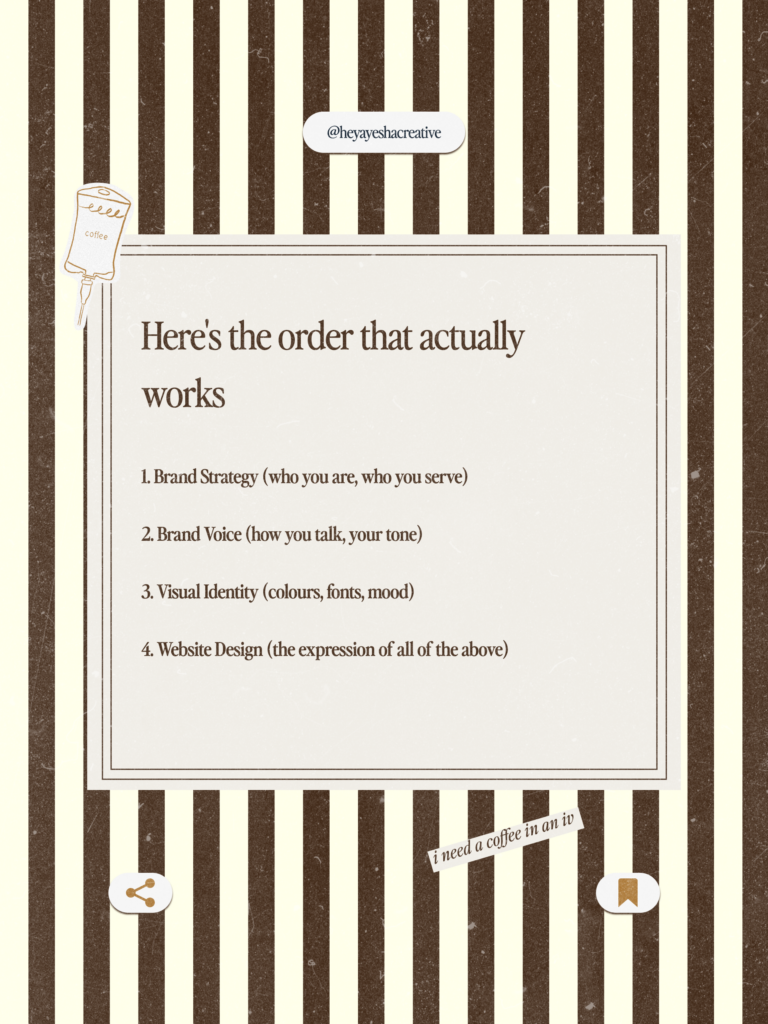
1. Brand Strategy (who you are, who you serve, what you stand for)
       ↓
2. Brand Voice & Messaging (how you talk, your tone, your language)
       ↓
3. Visual Identity (colours, fonts, mood, photography style)
       ↓
4. Website Design (the expression of all the above)
The website is step 4. Most people try to start there.
Supporting Data
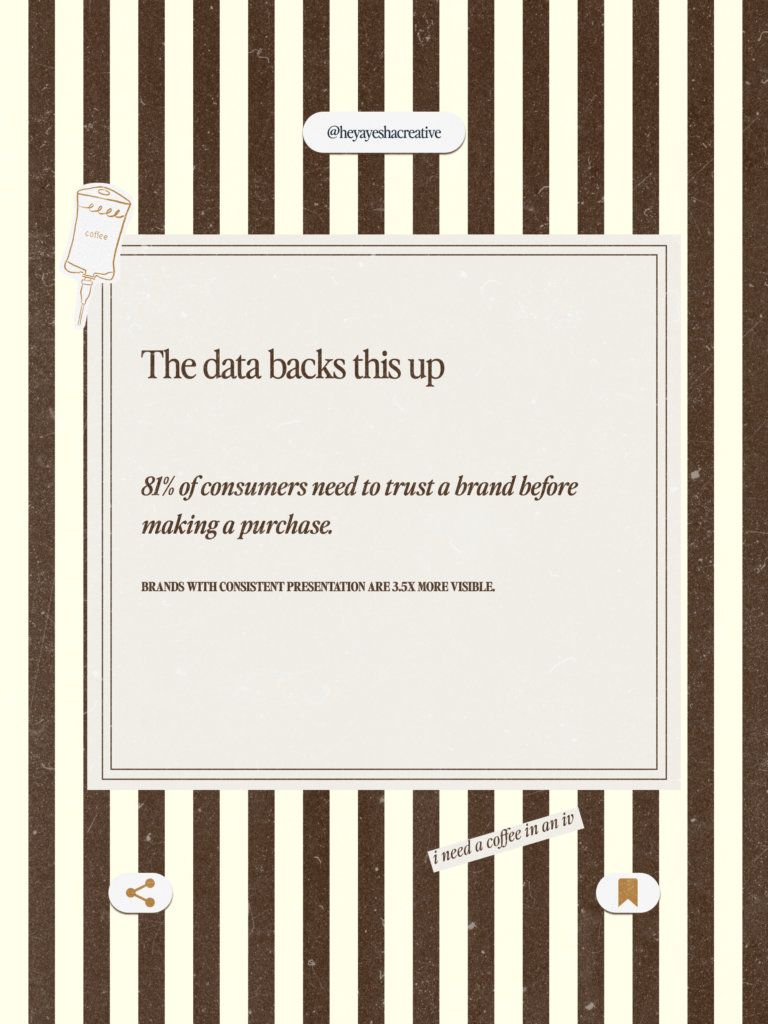
The data back this up.
- 81% of consumers need to trust a brand before buying
- Brands with consistent presentation are 3.5x more visible
- Brand consistency can boost revenue by 23–33%
- 94% of consumers stay loyal to brands that are open and honest
- A 5% increase in brand loyalty can boost profits by up to 95%
That consistency everyone’s talking about? It starts here. Not at the website. Not at the logo. Here.
The 7 Things to Define Before You Build
1. Your One-Sentence Purpose
Can you explain what you do in one clear sentence? Not a paragraph. Not “well, it’s complicated.” One breath. Who you help and how.
This is harder than it sounds—and that’s the point. If you can’t say it simply, your audience won’t get it either. And if they don’t get it, they’re bouncing off your homepage in 0.05 seconds.
Exercise: Set a 5-minute timer and write 10 versions of “I help [who] do [what].” Pick the one that feels most true. That’s your starting point.
2. The 3–5 Rules You Won’t Break
These aren’t aspirational buzzwords for your website footer. They’re the principles you operate by—the ones you’d stick to even if it cost you money.
Think about:
- A time you said no to a client or project. Why?
- What makes you angry about your industry?
- What hill would you die on?
Those answers? Those are your real values. Not “integrity” and “excellence”—those are filler words. What do you actually believe?
Test: If someone shadowed you for a week, what would they observe? That’s the truth. Not what looks good on a poster.
3. What Makes You Different (and Why It Matters)
If your audience can’t see what makes you stand out, they will choose the cheapest option. They might also go for whoever is easiest to find. That’s how it works.
Your differentiator isn’t one thing. It’s your unique mix of background, approach, audience, values, and perspective.
Exercise: Finish these sentences:
- “Unlike most [people in my industry], I…”
- “My clients come to me because they’re tired of…”
- “The thing I do that nobody else does the same way is…”
You’re not looking for a polished tagline here. You’re looking for the messy truth about why you exist. The tagline comes later.
4. Your 30-Second Introduction
When someone asks what you do, can you explain it in 2–3 sentences? Practice this until it feels natural.
Exercise: Record yourself explaining your business in a voice memo. Play it back and refine the version that sounds most conversational.
If it sounds like a press release, start again.
5. Your Origin Story (The Short Version)
Every brand has a story. It doesn’t need to be dramatic—just real.
A strong origin story connects three things:
- Their struggle — what your audience is dealing with
- Your experience — why you understand it personally
- Your solution — what you decided to do about it
I’ve got a bit of a backstory. I didn’t like seeing the tech industry lecture creative business owners. Instead of leaving them confused, I chose to help them.
Your origin story shows up everywhere—your about page, sales copy, and social media intro. It’s the thread that ties your brand together.
6. How Your Brand Sounds
Your brand has a personality. “Professional” is a baseline, not a personality. What kind of professional? Warm and reassuring? Bold and opinionated? Playful and irreverent?
Exercise: The Group Chat Test
Imagine your brand is a person in your group chat. How do they text?
- Do they use emojis or full stops?
- Are they cracking jokes or giving thoughtful advice?
- Do they type in all caps when excited or keep it composed?
- What would they never say?
Pick 3–5 words that describe that personality. For each one, note why that trait matters. The “why” is what stops your voice from being generic. Many brands call themselves “friendly,” but how and why yours is different sets you apart.
Your voice stays consistent. Your tone shifts by context. Instagram Stories are casual, quick, and playful. Client proposals are thorough and easy to understand, with a friendly tone. But the underlying personality remains the same.
7. Your Boundaries List
Knowing what your brand isn’t is as important as knowing what it is.
Create a list of words, phrases, and tones your brand will never use. This keeps you true to yourself. It’s key, especially when you write at night or collaborate with others who may drift from your style.
Think about:
- Words that feel cheap, gimmicky, or off-brand
- Tones that don’t match your personality (overly corporate? Fake-cheerful? Condescending?)
- Industry jargon your audience wouldn’t use
- Competitors’ language you want to distance yourself from
This list is a filter. Run your drafts through it. If something triggers a boundary word—rewrite that part.
Visual Identity: Colours, Fonts, and Mood Board
Once your strategy is sorted, then you move to visuals. Not before.
Colour Palette
Your colours aren’t just aesthetic choices—they’re signals:
- 90% of first impressions are based on colour alone
- 85% of shoppers say colour is the main reason they choose a product
- Colour boosts brand recognition by up to 80%
What you need:
- 1–2 primary colours (your main brand colours)
- 2–3 secondary/accent colours
- 1 neutral (for backgrounds, text)
Stick to 4–5 colours maximum. Simplicity creates consistency.
Typography
Choose 2–3 fonts. Prioritise readability over aesthetics.
- Heading font — personality, character, can be decorative
- Body font — clean, readable, minimum 16px on web
- Accent font (optional) — for quotes, callouts, special elements
Mood Board
Make a visual collage that shows your brand’s vibe. Include colours, textures, photography styles, and sources of inspiration.
Use this as a reference when designing.
Where to build it: Pinterest board, Canva, Notion gallery, or a simple Google Slides deck.
Include:
- Colour swatches
- Font samples
- Photography styles you’re drawn to (here’s where to find them ethically -guide coming soon!)
- Texture/pattern references
- Brands whose visual style inspires you (not to copy—to understand the energy)
How to Know You’re Ready to Build
You’re ready to start your website when you can say YES to these:
Ethical photo sourcing guide (guide coming soon!)
If you’re missing any of these, that’s what to work on first. Not the website. This.
Once these are in place, the rest—copy, photos, SEO, design, launch—will flow much more easily.
TL;DR: The Brand Before the Build
- Your website is step 4, not step 1. Strategy → Voice → Visuals → Website.
- Nail down your identity first. Define your purpose in one sentence. Identify your values. What makes you unique? Consider your origin story. Think about your voice and your boundaries. Everything else will then come together clearly.
Clear is kind, and a clear brand makes everything easier.
Okaythanksbye. 💛
Need help defining your brand identity before you build? That’s part of my process—we don’t touch the website until we know who we’re building it for. Slide into my DMs.
Now you know who your brand is—so what’s next? Start with the website copy guide to put your brand voice into actual page content. Then source your photos ethically to match your mood board.
Related Posts:
- How to Source Free Stock Photos Ethically—Find photos that match your brand mood board
- SEO for Creative Business Owners—Your brand keywords become your SEO keywords
- How to Write Your Website Copy—Your brand voice makes copy writing 10x easier
Further Reading:


